The Math of the Singularity: Can Everything Know Everything?

This week we made the JobKick blog readable by AI agents. Part of that is a file called llms.txt: a plain-text summary of the site that an AI assistant can read in one gulp. It’s a 2024 proposal by Jeremy Howard “to provide information to help agents use a website.”
The first version had one problem. It was a snapshot. Publish a new post and the summary is wrong until somebody remembers to update it. So we made it rebuild itself every time the site does.
That’s a small fix to a small file. But it’s the smallest version of a very big question: what would it take for every system to stay aware of every other system? That’s one way to picture “the singularity”: everything connected, everything current, everything knowing everything. Let’s do the math, and then look at how the biggest systems we know actually handle it.
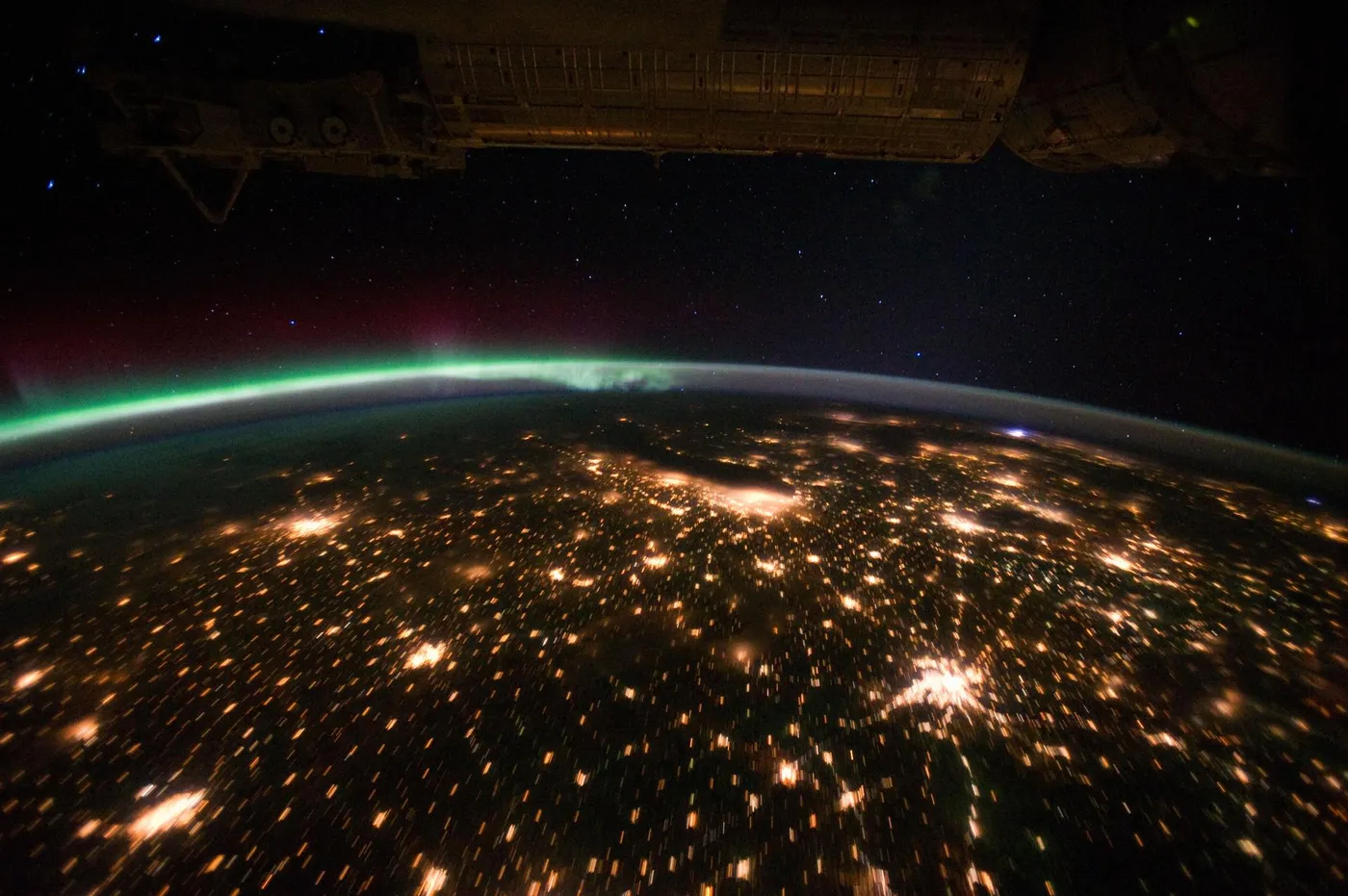
Every light is a town, and every town is wired to the others. The Midwestern United States at night, with the aurora borealis on the horizon, photographed from the International Space Station on September 29, 2011. (NASA, Expedition 29 crew.)
The spine: counting who has to know whom
Start with people, because the math is the same for people and for machines.
With n people, the number of two-way connections is n × (n − 1) ÷ 2. That’s Fred Brooks’s formula from The Mythical Man-Month, the same one behind the Kickoff Cliff. Five people have 10 connections. Fifty have 1,225.
But a connection isn’t awareness. “A knows what B is doing” and “B knows what A is doing” are two different facts, so one-way awareness is n × (n − 1).
And real coordination needs one more layer: A knowing what B knows about C. (“Does finance know the date moved?”) That’s every ordered trio of different people: n × (n − 1) × (n − 2). This is where it gets out of hand. Try it:
Formulas: pairs n(n−1)/2 (Brooks, 1975); ordered pairs n(n−1); ordered trios n(n−1)(n−2); hub-and-spoke n−1.
At 12 people, second-order awareness is 1,320 facts. At 150 it’s 3,307,800. At 1,000 it’s almost a billion. Add a fourth layer (“A knows that B knows that C knows…”) and it multiplies again.
That’s the honest shape of the dream. Every new member adds work for every existing one, and every layer of “knowing what others know” multiplies the total. In theory you can keep going. In practice it gets self-referential in several growing directions at once, and something has to pay for it.
Look for the similarities
Brains, friendships, the internet and Bitcoin look nothing alike. But when they get big, they hit the same wall, and they mostly climb it the same few ways.
Brains: sparse on purpose
The adult human brain has about 86 billion neurons (Azevedo and colleagues counted 86.1 billion on average in 2009). Wire every one to every other and you’d need about 3.7 sextillion connections.
The real brain doesn’t come close. The neocortex has roughly 0.15 quadrillion synapses (Pakkenberg and colleagues, 2003). Azevedo’s team found 19% of all neurons in the cerebral cortex, about 16 billion. Some rough arithmetic with those two studies: that’s around 9,000 synapses per cortical neuron, and about one connection for every million possible pairs.
The most capable system we know of is mostly not connected. That’s not a flaw. It’s the design.
People: an awareness budget
You’ve probably heard of Dunbar’s number: the idea that we can keep up stable relationships with about 150 people. It’s a good story. It’s also shakier than its fame suggests. A 2021 reanalysis by Lindenfors, Wartel and Lind reran the primate data and got estimates with 95% confidence intervals as wide as 4 to 520. Their conclusion: “specifying any one number is futile.”
I think both sides can be true. There’s no magic 150, but nobody keeps up with everyone. We all run on a budget of attention, and we spend it on a small, shifting circle. Same move as the brain: stay sparse.
Networks: not every link is worth the same
Metcalfe’s law says a network’s value grows with the square of its users, because that’s roughly how the number of possible connections grows. In 2006, Briscoe, Odlyzko and Tilly argued in IEEE Spectrum that it’s closer to n log n. Their reason: in a big network “most [potential connections] are not used at all,” so treating them all as equally valuable isn’t justified. Double a network from 100,000 to 200,000 members and Metcalfe says its value quadruples; n log n says it grows about 2.1 times.
Possible connections explode. Useful ones don’t.
Bitcoin: what it costs when everyone checks everything
Bitcoin is the closest thing we’ve built to “everyone knows everything.” Every full node checks every transaction against the shared ledger. That’s what makes it so hard to cheat.
The Lightning Network paper put the cost plainly in 2016: “If each node in the bitcoin network must know about every single transaction that occurs globally, that may create a significant drag.” At the time, Poon and Dryja wrote, Bitcoin handled fewer than 7 transactions per second, against Visa’s 47,000 peak. Matching Visa on-chain would mean over 400 terabytes of data a year, more than any home computer could keep up with.
Their answer is the same move again: most payments happen in two-party channels off the main chain, and only the opening and closing balances get broadcast to everyone. Keep the global agreement, but stop asking everyone to watch every step.
I don’t think that’s a prophecy of Bitcoin’s downfall, and I’d be wary of anyone who says it is. It’s a trade: total shared awareness buys trust, and it’s paid for in throughput and electricity.
AI: the energy bill for knowing more
Which brings us to the compute question. Do we have the energy for systems that know more and more about more and more?
Sources: IEA, Energy and AI (2025), Executive Summary · Cambridge Centre for Alternative Finance via Cambridge Judge Business School (2025)
The IEA puts data centres at about 415 terawatt-hours in 2024, roughly 1.5% of the world’s electricity, and expects that to more than double to around 945 by 2030, with AI as the biggest driver. Every extra layer of awareness gets paid for in power plants.
Snapshot, ask, or tell
Back to my little llms.txt file, because it shows the three ways any system can stay aware of another one:
- Snapshot. Write down what’s true and hope it stays true. Cheap, and stale the moment something changes. (A static
llms.txt. The org chart in a slide deck. A cached web page.) - Ask. Look it up when you need it. Always current, but someone has to answer. (A live API. MCP, “an open-source standard for connecting AI applications to external systems.” Walking over to someone’s desk.)
- Tell. When something changes, notify the few who need it. (Webhooks. IndexNow, which lets a site “instantly inform search engines” about changed pages instead of waiting to be crawled. That’s what this blog does when a post goes live.)
There’s an old programmer joke, usually credited to Phil Karlton: “There are only two hard things in Computer Science: cache invalidation and naming things.” Martin Fowler notes he couldn’t find an original source, so treat the attribution loosely. The joke lands because cache invalidation is this problem: knowing when your snapshot has stopped being true.
The fair counterpoint
None of this proves a singularity can’t happen. Hardware gets more efficient, and smart routing beats brute force all the time. The examples here are analogies, not a law of nature. A brain isn’t a blockchain.
But look at what they share. Not one of them got big by connecting everything to everything. They got big with:
- Sparsity: most possible links never form (the brain, the internet).
- Hubs: a few places that many things report to (Lightning channels, a team lead, a search engine).
- Asking on demand instead of storing everything everywhere.
- Telling on change instead of re-checking constantly.
- Forgetting: letting most details go, on purpose.
If there’s a singularity, I’d bet it looks less like a full mesh and more like a very good nervous system. The efficient version isn’t the one that knows everything. It’s the one that knows what not to know, and where to ask for the rest.
What to do with this
The same math runs a five-person team or a ten-app stack.
- Count your links. Before adding a person to a project or an integration to a stack, ask how many new “who needs to know” lines it creates.
- Pick snapshot, ask or tell on purpose for each thing others depend on. If it changes often, don’t make it a snapshot.
- Use a hub where it helps. One shared place beats everyone updating everyone.
- Let things go. Decide what most people (and most systems) don’t need to track.
And yes, this post practices what it preaches: there’s a Markdown version of it for AI agents, it’s listed in our llms.txt, and when it went live, the site told the search engines instead of waiting for them to notice.
Where do you think the wall is: energy, math, or us? Tell me in the comments.
Sources
- Azevedo, F. A. C. et al. (2009). Equal numbers of neuronal and nonneuronal cells make the human brain an isometrically scaled-up primate brain. Journal of Comparative Neurology 513(5).
- Pakkenberg, B. et al. (2003). Aging and the human neocortex. Experimental Gerontology 38(1–2).
- Lindenfors, P., Wartel, A. & Lind, J. (2021). ‘Dunbar’s number’ deconstructed. Biology Letters 17(5).
- Briscoe, B., Odlyzko, A. & Tilly, B. (2006). Metcalfe’s Law is Wrong. IEEE Spectrum.
- Poon, J. & Dryja, T. (2016). The Bitcoin Lightning Network: Scalable Off-Chain Instant Payments (draft 0.5.9.2).
- Cambridge Centre for Alternative Finance (2025). Cambridge study: sustainable energy rising in Bitcoin mining. Survey of 49 mining firms.
- International Energy Agency (2025). Energy and AI.
- Brooks, F. P. (1975). The Mythical Man-Month. Addison-Wesley.
- Howard, J. (2024). The /llms.txt file.
- Model Context Protocol: What is MCP?
- IndexNow
- Fowler, M. TwoHardThings.
 JobKick support
Comments
Loading comments…