The Anchor Isn't Real. So Who Made This Video?

This Is Propaganda is a new series. Each part takes one video or post and asks two questions: is the information real, and, more important, who made it and why?
Here’s the video: “Apple Just Made a Chip Breakthrough Nobody Thought Was Possible!” It runs 22 minutes and 52 seconds. A calm, well-dressed man presents it like the evening news.
He isn’t real. He’s an AI-made presenter, and his face was modeled on a real news anchor from Singapore. I’m not going to name that anchor. He didn’t make this video. He’s the one being used.
So the interesting question isn’t whether Apple made a breakthrough. It’s who sat down and built a fake newsreader to tell you so.
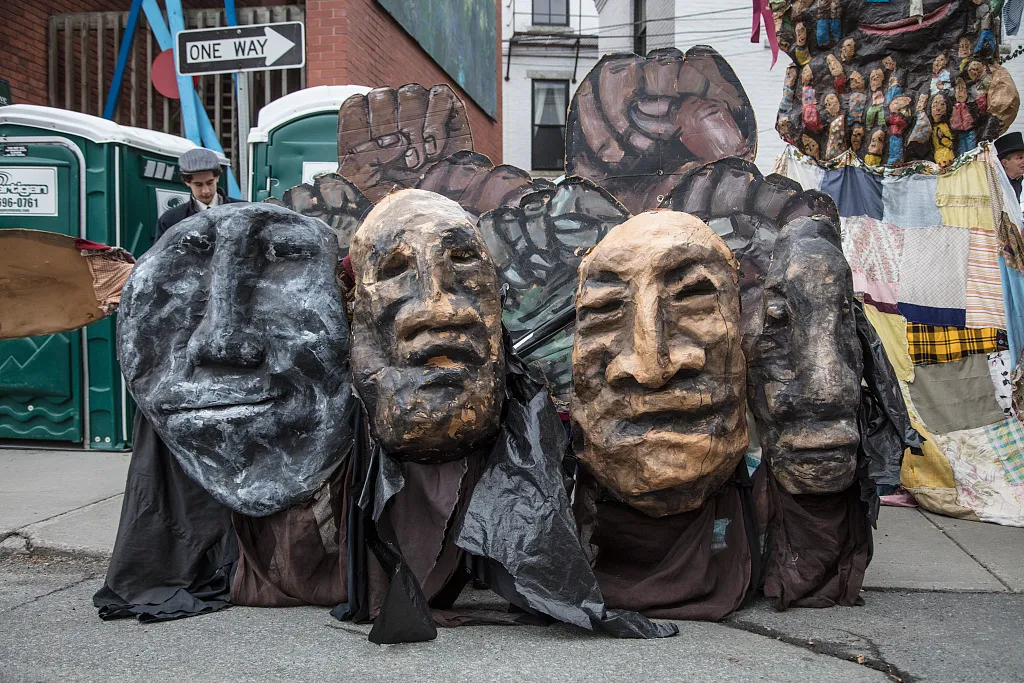
A face is the easiest thing to borrow. Bread and Puppet Theater masks at a street festival in Montpelier, Vermont. Photo: Carol M. Highsmith, 2017, public domain (Library of Congress).
Who made it
The video comes from a YouTube channel called Tech Unveiled. Its About page answers a lot, if you look:
- It joined YouTube on July 7, 2026. It’s less than four months old.
- It has 252 subscribers and 38,700 views across all its videos.
- It lists its country as the United States. There’s no person, company or contact behind it, just a slogan: “Discover What’s Next.”
Then scroll the Videos tab. Until about a month ago, this was not a tech channel. It posted “JAMES WEBB JUST FOUND SOMETHING STRANGE ON PLUTO,” “Grok AI ‘Decoded’ Sumerian Tablets,” “ELON MUSK’S AI WAS ASKED ‘WHO IS JESUS?’” and a run of videos about the interstellar comet 3I/ATLAS sending “flashing signals toward Earth.”
In the past ten days it switched to Linux, Windows, Microsoft and Apple, about one video a day, nearly all 15 to 23 minutes long. “Delete Google Chrome NOW.” “Microsoft Just Swallowed GitHub.”
That pattern tells you more than any single claim. A real tech journalist doesn’t spend two months on ancient Egypt and Pluto, then wake up as a hardware reporter. A channel that’s testing which topics pay does.
Is the information legit?
Whatever this video says, Apple’s actual chip news is on its own site. On August 25, 2026, Apple announced M6, its first chip built on a 2-nanometer process. Apple’s own claim is up to 1.2 times faster multithreaded performance than last year’s M5.
That’s real progress: a solid step up from last year’s chip. “Nobody thought was possible” is the title doing its job, not a fact.
This is how these videos usually work. They start from something true, then stretch it. The true part makes the stretched part feel safe to believe.
It’s a pattern, not one channel
In July, CNA (Channel News Asia, Singapore’s national broadcaster) looked into a bigger version of the same thing: AI-made videos of Alibaba founder Jack Ma “talking” about Singapore.
Some of those channels were set up within five days of each other. On at least two occasions, separate channels uploaded videos one second apart. That’s not a fan. That’s a machine with a schedule.
Professor Anthony Tung of the National University of Singapore put it well: what’s being exploited is “authority bias, our tendency to trust the word of authority figures.” The people behind it are “renting authority, not renting Jack Ma.”
That’s exactly what a borrowed news anchor does. You aren’t trusting a channel with 252 subscribers. You’re trusting a face that looks like it reads the news for a living.
Why your eyes won’t save you
The usual advice is “look for the glitches.” That advice is getting old fast.
In September, researchers released DF26, a test set of AI-made videos of people speaking to camera, in interviews and in official footage, built with seven of this year’s video generators, including Google’s Veo 3.1 and Kling 3.0. They showed short clips to volunteer students, mostly from technical universities, and compared their results with two older deepfake test sets.
Source: Shykula et al., "DF26: We Cannot Tell Fake From Real Anymore," arXiv, Sept. 2026, Table 7. Accuracy on real clips was similar across all three (72.8–76.0%).
On this year’s fakes, people were right 52.6% of the time. That’s barely better than guessing. The researchers found state-of-the-art detection software close to chance too.
So “it looked real to me” is no longer evidence of anything. Checking who made it is.
The fair counterpoint
Not every AI voice or AI presenter is propaganda. Plenty of honest creators use AI narration because they’re camera-shy, don’t speak English as a first language, or work alone. YouTube allows AI-made content.
What YouTube asks for is disclosure. Its rules require creators to label realistic AI content, and one of its examples is content that “makes a real person appear to say or do something they didn’t do.” Since July 2025, it has also said “mass-produced” videos made from “generic or unoriginal templates” can’t earn money from ads.
So the line isn’t “AI was used.” The line is a borrowed face, an anonymous maker and a claim built to travel. When all three show up together, be careful.
And most of the time the motive isn’t some grand plot. It’s money and reach. That’s still propaganda in the plain sense: a message shaped to move you, by someone who’d rather you didn’t know who they are.
What to check, in about two minutes
- Open the channel’s About page first. When did it join? Is there a real person or company named? A months-old channel with a confident news anchor is a flag.
- Scroll its videos. A channel that jumps from Pluto to Jesus to Linux is chasing clicks, not covering a beat.
- Look for the AI label. Check the description and the player for “Altered or synthetic content.” No label proves nothing, but a missing one on an obviously fake presenter tells you something about the maker.
- Go to the source the video is about. A claim about Apple? Apple’s newsroom. A claim about a law? The government’s site. If the original doesn’t say it, the video is the only one saying it.
- Don’t use your eyes as the test. At 52.6%, you’re flipping a coin. Use the channel’s history instead.
- Don’t share it to ask if it’s real. Every share is a view, and views are the product.
I’ll keep doing these. If you’ve run into a video like this, a fake expert, a borrowed face or a channel that changed its whole personality overnight, send it my way in the comments. It might be part 2.
Sources
- Tech Unveiled, “Apple Just Made a Chip Breakthrough Nobody Thought Was Possible!,” YouTube, Oct. 2026; channel About and Videos pages (@TechUnveiled-f6i), viewed Oct. 31, 2026.
- Apple Newsroom, “Apple introduces M6 and M5 Ultra for a big leap in performance and AI compute,” Aug. 25, 2026 (Apple’s own performance claims).
- Lakshmi Prabha, “Jack Ma Targeted By AI Deepfakes: Fake Videos Falsely Portray Alibaba Founder Discussing Singapore,” IBTimes Singapore, July 28, 2026, reporting a CNA investigation.
- NUS School of Computing, “Some 260 fake Jack Ma videos spreading falsehoods about Singapore on YouTube: CNA investigation,” July 2026 (the headline says about 260 videos; the summary says over 300).
- Shykula, Yermakov, Samarskyi, Mishkin, Cech & Mishchuk, “DF26: We Cannot Tell Fake From Real Anymore,” arXiv, Sept. 7, 2026: 2,691 clips (271 real, 2,420 AI-made), 232 human labeling sessions by volunteer students.
- YouTube Help, “Disclosing use of altered or synthetic content.”
- YouTube Help, “YouTube channel monetization policies,” inauthentic content update of July 15, 2025.
 JobKick support
Comments
Loading comments…