So You Want to Be a YouTube Star (With Two Friends)

This one is personal. Three of us came up as young DJs around New York City. We hung out, traded records and played out. Now we want to start a YouTube channel together, and we live in three different states.
Here’s the crew. One of us lives in Texas. He played drum and bass, works for a major plumbing company now, and builds AI apps for fun. One of us played funky house and spent about 15 years in IT support. He’s done video editing too, but he’ll tell you he doesn’t remember any of it; it’s been a long time since he touched the software. And then me. I had residencies at Limelight, Twilo and the Tunnel, went into healthcare systems development, and these days build my own things: JobKick; Sonyk, a DJ groove box app; helpfulsoul.com, a site for local businesses; and a burrito spot, El Barrio Burritos. I’ve even been playing out again lately, at La Noxe.
So between us: real skills, real jobs, and a history of being a little unreliable with each other. Me included.
We all know how friend channels usually go. The first video takes three weeks. The second is “almost done” for a month. Somebody’s waiting on somebody’s audio, nobody wants to nag, and by video three the chat has gone quiet. Nobody quits. The channel dies in the handoffs, and when you’re remote, the whole channel is handoffs.
So here’s the plan I’d put in front of my two friends, and the one I’d hand anyone else starting a channel with people in other places.
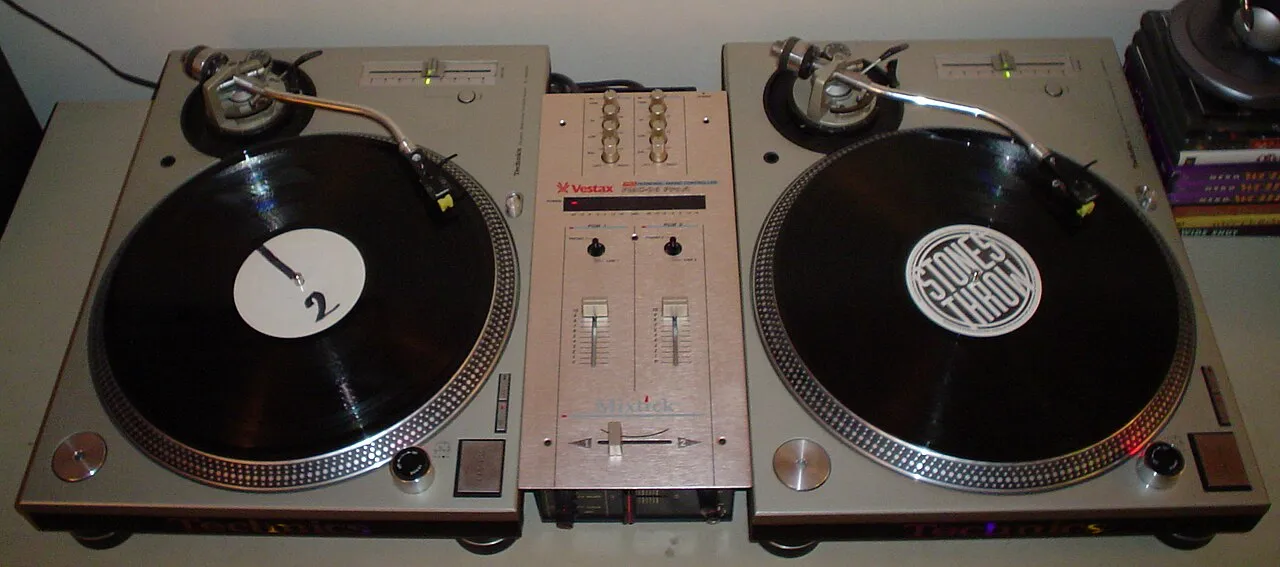
The classic setup: two Technics 1200s and a Vestax mixer. Photo by Baskoner, 2004, via Wikimedia Commons, CC BY 3.0 (resized).
First, know what you’re signing up for
YouTube is a long game, even for people who are good at it.
That last number is the one to sit with. These are the successful channels, and only a little over half got a video out that week. The other 44% posted nothing.
So the goal for three beginners isn’t “go viral,” and it isn’t reliving the Tunnel. It’s “still be posting in a year.” That’s a team problem, not a talent problem.
Why “we’ll all pitch in” doesn’t work
Psychologists call it social loafing: putting in less effort in a group than alone. Steven Karau and Kipling Williams pulled together 78 studies on it in 1993 and found it holds up across tasks and groups. The useful part is what shrank it. Effort went up when each person’s contribution could be seen and evaluated, when people expected their partners to do their part, and when the work felt meaningful.
For three friends, that means: every job has one name on it, everyone can see who’s done what, and the channel is about something you all care about.
Distance makes that harder. Online, a friend who’s been editing all weekend and a friend who forgot look the same: quiet.
Accountability works better when it’s boring
There’s a small study coaches love to quote. Gail Matthews at Dominican University of California had 149 people pick a four-week goal and randomly assigned them to five groups, from “just think about your goal” up to “write it down, commit to actions, and send a friend a weekly progress report.”
Source: Gail Matthews, Dominican University of California, goals research summary (149 participants, self-rated progress).
It’s a modest, self-rated study, so I wouldn’t build a religion on it. But it points the same way as the loafing research: work someone will see on a schedule tends to get done.
Backup plans are just “if-then” sentences
The best-supported tool here is almost embarrassingly simple: an implementation intention, a plan in the form “if X happens, then I’ll do Y.” Peter Gollwitzer and Paschal Sheeran combined 94 tests of it in 2006 and found a medium-to-large effect on reaching goals (d = 0.65), partly because it protects a goal when something gets in the way.
That’s what a backup plan is. “We’ll figure it out” isn’t one. “If the edit isn’t in by Thursday, the files go to the backup editor Friday” is.
How I’d set it up
1. Split the work into three jobs, and give each one an owner and a backup.
A beginner video has three kinds of work, and three friends who are tech savvy in different ways usually map onto them well:
- Story (idea, script, title). Whoever has the most opinions.
- Record (running the call, everyone’s setup, collecting files). Whoever likes gear and doesn’t mind troubleshooting.
- Ship (edit, thumbnail, captions, upload). Whoever can sit with a timeline for four hours.
Each job gets one owner, and each person is the named backup for one other job, so no job lives in one head.
For us, on paper: fifteen years of IT support is who you want fixing three home setups over a call, so that’s Record. Our editing is rusty, so Ship should expect a few weeks of relearning, with the backup editor learning alongside. Plan for it instead of pretending.
Remote, Record matters most. The Record owner sets one standard for everyone’s room: same resolution and frame rate, a decent mic, light in front of your face. Each person records their own camera and mic locally and uploads the file after, so a bad connection doesn’t wreck the footage. Clap at the start of each take so the editor can line up the files.
2. Write a one-page channel agreement before the first video.
Cover the cadence, what “done” means, how you break ties (two out of three wins), what happens to the channel and any money if someone steps away, and who has access. Use YouTube’s built-in channel permissions (Owner, Manager, Editor and more); its help page says that’s safer than sharing a password. Add a fixed recording slot, written in everyone’s local time zone. “Whenever works” never works across three calendars.
3. Pick a pace you can keep on your worst month.
YouTube’s own advice: a “consistent” and “sustainable” schedule, with scheduled uploads. For three beginners with jobs, I’d start with one video every two weeks and bank two finished videos before publishing the first. That bank is the real backup plan: when someone gets sick or the Wi-Fi dies, you post from the bank.
4. Run every video on the same two-week clock.
| Day | What’s due | Owner |
|---|---|---|
| 1 | Idea locked, one-line pitch in the shared list | Story |
| 3 | Outline or script shared | Story |
| 4 | Ten-minute setup check on a call (mic, light, settings) | Record |
| 5 | Recording session at the fixed slot | Record (everyone on the call) |
| 6 | Everyone’s own files uploaded to the shared folder | Each person, checked by Record |
| 10 | First cut shared for notes | Ship |
| 11 | Notes back (24 hours, then silence counts as yes) | Everyone |
| 12 | Final cut, thumbnail, title, scheduled | Ship |
| 14 | It goes live | Nobody has to be there |
You only need all three of you at once on day 5. And “silence counts as yes” matters more than it looks: most stalls are somebody waiting on a reply.
5. Write your if-thens down. Three to start:
- If someone’s files aren’t in by end of day 6, then the editor uses the call recording for their parts.
- If the first cut isn’t shared by day 10, then the backup editor takes over.
- If one of us misses the recording slot, then the other two record and the third adds a short piece later. If two miss it, we post from the bank.
That first one only works if you always record the call itself too. It’s the cheapest backup you’ll ever have.
6. Send a weekly progress message. Same day each week: what I finished, what I’m stuck on, what I need from you. It’s how you know someone’s busy rather than gone.
7. Keep one shared list where every task has a name and a date. Any tool works, even a spreadsheet. Everyone can see the work, which is what shrank social loafing.
8. Review at 90 days. Six or seven videos in, look at what people actually did, not what they signed up for. Swap jobs or change the pace. Then go another 90 days.
What we could make
A starting list, pulled from our own history:
- Back in the booth: stories from Limelight, Twilo and the Tunnel.
- Drum and bass vs. funky house: two genres, one argument, with records.
- Coming back after 15 years: relearning video editing from zero, on camera.
- Building apps with AI after work: what someone with a full-time trade job can build at night.
- Making a groove box: building Sonyk, with Ableton Link, AirPlay and beats that play in time with DJ tracks, a feature you rarely see in music apps.
- Back behind the decks: what’s changed about playing out, from someone doing it again.
- A B2B set across three states: can three DJs play together over the internet?
- Day jobs: what DJing taught us about plumbing, IT support and healthcare software.
- No room on the wall: El Barrio Burritos didn’t have space for a real bulletin board, so it got helpfulsoul.com instead: a community board, owner-first reviews where feedback goes straight to the business, and storefront sites. The restaurant’s own site, elbarriobk.com, is built on it.
Which one would you watch first? Tell us in the comments. If one wins, that’s video one.
The fair counterpoint
You’re friends, not a company. Too much structure can kill the fun, and “unreliable” usually means jobs and lives, not that people don’t care. When you live far apart, the channel might be the main reason you talk every week. Don’t bury that in process.
I agree, and it’s why the structure is about the work, not each other. A system that assumes someone will flake now and then is kinder than one that depends on nobody ever flaking. Nobody has to nag. The plan does the reminding.
The honest close
Most friend channels don’t end in a fight. They fade out, and distance makes fading easier. Make the work visible, give every job a backup and keep two videos in the bank, and you have a real shot at still posting a year from now.
We haven’t shot video one yet. If you’ve started a channel or any side project with friends in other cities, what killed it or what kept it going? And which of the nine ideas above should we make first? Tell me in the comments.
Sources
- YouTube Help, YouTube Partner Program overview and eligibility.
- Pew Research Center (2019), A Week in the Life of Popular YouTube Channels. 43,770 channels with 250,000+ subscribers, first week of 2019.
- Karau, S. J., & Williams, K. D. (1993), Social loafing: A meta-analytic review and theoretical integration. Journal of Personality and Social Psychology, 65(4). 78 studies.
- Matthews, G., Dominican University of California, Goals research summary. 149 participants; not peer-reviewed.
- Gollwitzer, P. M., & Sheeran, P. (2006), Implementation intentions and goal achievement: A meta-analysis of effects and processes. Advances in Experimental Social Psychology, 38. 94 tests.
- YouTube Help, Upload schedule tips.
- YouTube Help, Channel permissions.
 JobKick support

Comments
Loading comments…