And Just Like That, We Gave It All Away

People are spinning up AI bots to manage their day. They read the email, sort the calendar, draft the replies and decide what matters this morning.
Most of us aren’t there yet. But we’ve all let AI write a document for us, then skimmed it instead of reading the whole thing. Before that, we let a calculator add the numbers and stopped doing the math ourselves. The word processor made it easy to fix mistakes, so we got less careful putting words together. The phone changed how we talk to each other. Go back far enough and the wheel stopped us walking everywhere.
Each handoff felt small. That’s the question I can’t shake: are we giving up our agency, and is it now happening exponentially? And if so, how do we move forward carefully, on purpose, instead of waking up one day to find we gave it all away?
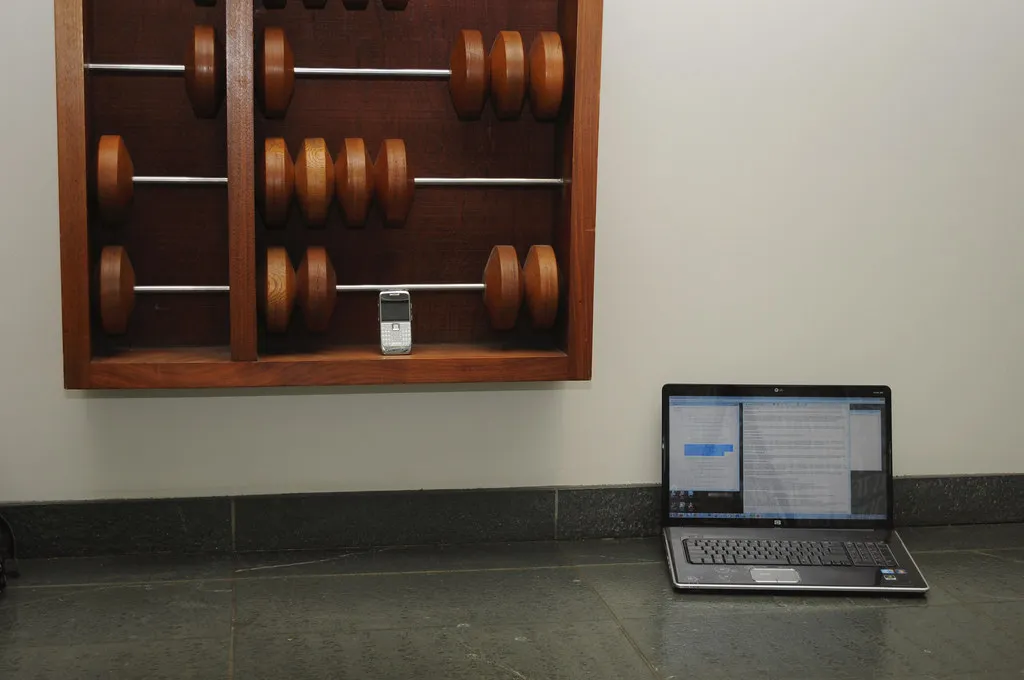
Three generations of tools that think for us, in one hallway. Photo: D Coetzee, CC0 public domain (via Openverse).
Can it be quantified?
Half of it can. The machine’s side is measured, and it is exponential.
The research group METR times how long a task takes a skilled person, then checks which tasks an AI agent can finish on its own. The yardstick is the task length where the AI succeeds half the time. In 2025 they found it had doubled about every 7 months for six years. Their current data puts the doubling since 2023 closer to 4 months.
Source: METR, Task-Completion Time Horizons of Frontier AI Models, Time Horizon 1.1 data file (benchmark_results_1_1.yaml). Background: METR, 2025.
Two honest caveats. These are software tasks, not life. And METR itself warns the numbers depend on which tasks and which people you measure against. Still, it’s a curve, and it bends up.
The human side is harder. Nobody measures “agency handed over.” What we have are smaller studies of what happens to us when we lean on a tool.
- Trust goes up, thinking goes down. Microsoft Research and Carnegie Mellon surveyed 319 knowledge workers about 936 real examples of using AI at work. The more people trusted the AI, the less critical thinking they reported. The more they trusted themselves, the more they did. Self-reported, and a correlation, not proof.
- You don’t own what you didn’t write. In an MIT study, 54 people wrote essays with ChatGPT, a search engine, or nothing. The ChatGPT group showed the weakest brain connectivity, felt the least ownership, and 83% couldn’t correctly quote a sentence they’d just written. With search or no tool, 11% couldn’t. It’s a small, not-yet-peer-reviewed study, and the authors say so.
- Skills fade when we stop using them. Two neuroscientists tested 50 regular drivers. More lifetime GPS use went with worse spatial memory when they had to find their own way. Among 13 retested three years later, more GPS use went with a steeper decline. The authors caution against strong conclusions.
So here’s my honest answer. What AI can do is growing exponentially. Whether our agency shrinks at the same rate is a choice, made one small handoff at a time.
The fair case: we’ve panicked before
About 2,400 years ago, Socrates told a story about the god who invented writing. The king he showed it to was not impressed:
“This discovery of yours will create forgetfulness in the learners’ souls, because they will not use their memories… they will appear to be omniscient and will generally know nothing.”
Writing did change memory. It also gave us science, law and this blog. Calculators are the same story. A meta-analysis of 53 classroom studies found students’ problem-solving improved when calculators were part of math class, and most students’ paper-and-pencil skills held steady or improved.
The wheel stopped us walking everywhere, and that freed us to go further. Handing things off is how humans make progress. Not every handoff is a loss.
Where it goes wrong
In 1983, the engineer Lisanne Bainbridge wrote a short paper called Ironies of Automation. Her point: when you automate a job, the person is left with the hardest part, watching the machine and stepping in when it fails. And people are bad at that. “Physical skills deteriorate when they are not used,” she wrote, and nobody can keep effective watch “for more than about half an hour.”
That’s my worry with AI, and it’s different from the calculator. A calculator does one narrow thing. AI drafts the email, reads the report, picks the priority. We’re left to approve what it did, and approving is the easiest thing in the world to do without looking.
Society hasn’t settled this. In a 2025 Pew survey of 5,023 Americans, 50% were more concerned than excited about AI in daily life. 53% expected it to make people worse at thinking creatively, and 50% worse at forming meaningful relationships. About six in ten wanted more control. That’s a conversation we need to have out loud, not just on our phones.
How to move forward on purpose
None of this means stop. It means decide.
- Name what you never delegate. The final call on anything that affects a person. What you say to someone you love. Write your list down.
- Think first, then ask. Write your own rough answer before you prompt. Then the AI is checking you, not replacing you.
- Read what you put your name on. If you didn’t read it, you didn’t send it. The AI did.
- Keep one skill in practice on purpose. Do the math by hand now and then. Navigate without the map. Write one thing a week from scratch.
- Make the handoff visible. At work, say when AI did the work and who checked it. Agency you can see is agency you can take back.
And as a society: ask for the controls people already say they want, and design tools that keep humans deciding, not just approving.
So, did we give it all away?
Not yet. The curve is real, and it isn’t slowing. But the giving away is still ours to do, or not. I’d rather we talk about it now, while it’s still a choice.
What have you stopped doing because a phone or an AI does it now? Do you miss it? Tell me in the comments.
Sources
- METR (2025), Measuring AI Ability to Complete Long Tasks; METR, Task-Completion Time Horizons of Frontier AI Models and Time Horizon 1.1 data (doubling time since 2023: 129 days).
- Lee et al., Microsoft Research and Carnegie Mellon (2025), The Impact of Generative AI on Critical Thinking, CHI 2025. 319 knowledge workers, 936 examples.
- Kosmyna et al., MIT Media Lab (2025), Your Brain on ChatGPT, preprint. 54 participants; 15 of 18 in the LLM group couldn’t correctly quote their essay in session 1, vs. 2 of 18 in each other group.
- Dahmani & Bohbot (2020), Habitual use of GPS negatively impacts spatial memory during self-guided navigation, Scientific Reports. 50 drivers; 13 retested after 3 years.
- Plato, Phaedrus, trans. Benjamin Jowett.
- Ellington (2000), Effects of hand-held calculators on precollege students in mathematics classes: a meta-analysis, University of Tennessee. 53 studies.
- Bainbridge (1983), Ironies of Automation, Automatica 19(6). Quotes via The Morning Paper.
- Pew Research Center (2025), How Americans View AI and Its Impact on People and Society. 5,023 U.S. adults, June 9–15, 2025.
- Photo: “Soda Hall abacus with laptop and smartphone – closeup,” D Coetzee on Flickr, CC0 1.0 public domain.
 JobKick support
Comments
Loading comments…