Why I Built Sonyk: From Vinyl to Vision Pro

I started out as a club DJ mixing vinyl. These days I spin on a Denon SC6000M at home. And for a long time, I’ve wanted one thing I could never quite find: a way to make beats live.
Not in a studio, one track at a time. Live. The way you play a set.
I’ve tried a lot of things. I’ve played with plenty of hardware. I’ve used DJ gear and software like Traktor and Logic Pro, and I’ve produced a few tracks of my own. All of it works. Most of it is very good. But I never found anything that was fun to play.
So I built it. It’s called Sonyk, and this is why.
“Works” and “fun to play” are different things
This is the same idea I keep coming back to with work software. A tool can get the job done and still be no fun to use. Most music software is built to finish a track. It’s a workbench: grids, menus, a mouse, a lot of clicking. That’s great when you’re producing. It’s not great when you just want to play.
DJ gear is the opposite. It’s built for a crowd. You put your hands on it and things happen right now. But it plays records. It doesn’t help you make the beat.
I wanted both in one place. Something that lets you:
- make a beat quickly, before the idea goes away,
- reach for lots of different instruments without opening a new window for each one,
- get a nudge when you’re stuck, from patterns that write themselves,
- then play it out, on decks, like a set.
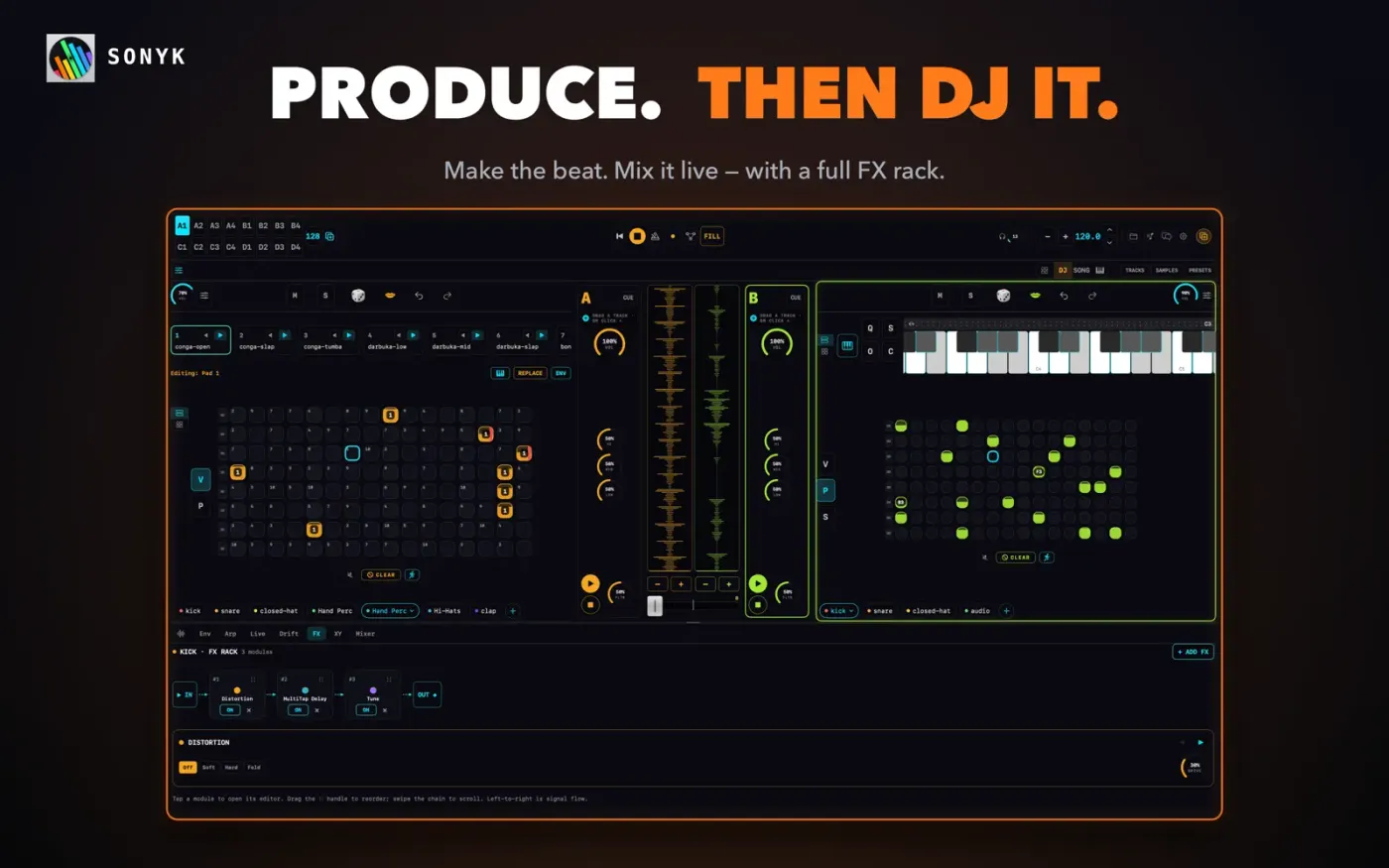
Sonyk on Mac: make the beat, then mix it live. (App Store screenshot.)
Patterns inspired by Moroder, Beethoven and Mozart
Sonyk uses generative patterns (patterns the app writes for you, which you then keep, change or throw away). Mine are inspired by Giorgio Moroder, Beethoven and Mozart.
Moroder is the obvious one for anyone who grew up on dance music. When he and Pete Bellotte made Donna Summer’s “I Feel Love” in 1977, most disco records were still backed by orchestras. They built it on a Moog synthesizer, with the parts programmed on a sequencer. According to Wikipedia’s history of the record, the kick drum and the vocals were the only things not played by a machine. Brian Eno reportedly told David Bowie he’d heard “the sound of the future.”
Letting a system write music isn’t new either. In 1792, Mozart’s publisher put out a “musical dice game”: roll the dice, and each roll picks one small piece of music to stitch into a waltz. The cover credited Mozart, though that has never been confirmed. Do the math on the possible combinations and you get 759,499,667,166,482 different waltzes. That’s about 759 trillion, from a pair of dice and a table.
Sonyk has dice too. Tap them on an empty pattern and it writes a real starting point, according to the App Store listing: a house or drum-and-bass kick, hats that swing, an acid line with its slides. You don’t have to keep it. It’s there to get you moving.
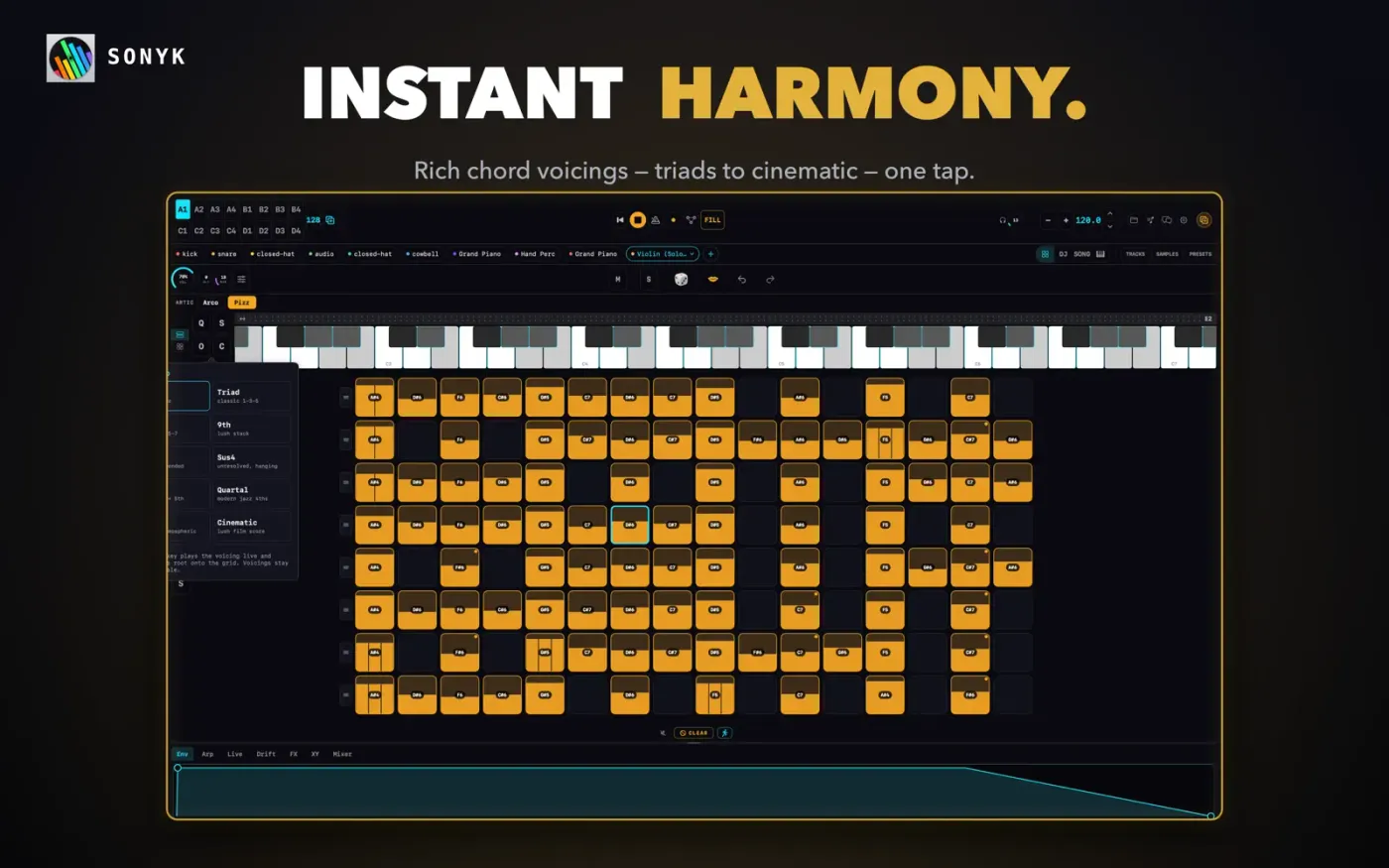
Chord voicings, from simple triads to cinematic, in one tap. (App Store screenshot.)
The fair objection: is it still playing?
Not everyone loved what Moroder did. In a 1981 interview with the Los Angeles Times, republished by The Guardian, Robert Moog, the man who built the synthesizer, said that on “I Feel Love” Summer “sounded like she was fighting the sequencer.” He added: “The audience expects a musician to be doing something.”
That’s a real criticism, and I think it still applies. A lot of music software, and a lot of AI music, can make something that sounds finished while nobody is really playing it. Press a button, get a track.
In Sonyk, the generative patterns are a starting point, not the performance. You still pick the sounds, change the pattern, mix it, ride the filter, drop the beat on decks. The machine does the setup. You do the playing.
The Vision Pro version: Minority Report, on a dance floor
Then there’s the Vision Pro version.
The idea was to make it feel like you’re playing Minority Report-style futuristic music equipment, in front of a Sound Factory dance floor. If you never went: the original Sound Factory was a club in Chelsea, Manhattan, and Junior Vasquez was its DJ from 1989 until it closed in 1995. He was also linked with the House of Xtravaganza, one of the ballroom houses big in New York at the time.
So in Sonyk, there’s a dance floor in front of you. Junior’s spotlight shines from the DJ booth to light up the runway. And vogue queens dance to fill the floor.
They’re a little like Lego characters, on purpose. The Vision Pro headset can’t support realistic-looking people dancing around a room, so they’re stylized 3D characters instead.
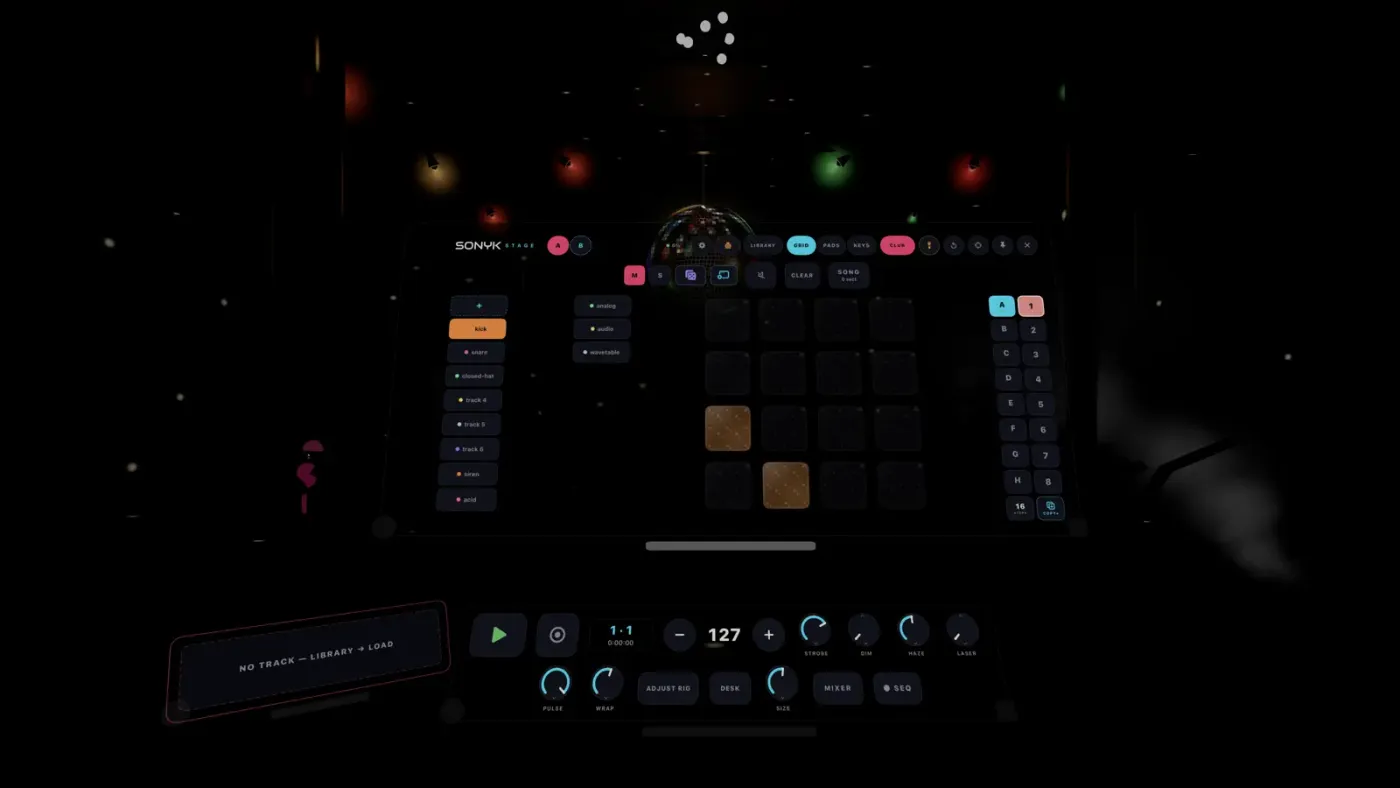
Sonyk on Vision Pro: the console floats in front of the club. (App Store screenshot.)
How AI fits in
I didn’t build Sonyk alone in the old sense. I built it working with AI coding agents (AI tools that can read a codebase, write code and run it), the same way I build everything now. I wrote about that way of working in Why I Built JobKick.
AI helped me build several different kinds of synths with truly imaginative, unique playing surfaces. It also let me recreate a lot of features I’d seen in other music software. The agents bring speed. Knowing what a playing surface should feel like under your hands, after years behind decks, still has to come from the person building it.
What’s in it
If you want to try it, here’s what the App Store listing describes:
- Make beats: a fast step sequencer with swing and per-step pitch, a synthesized drum kit, and the dice.
- Play instruments: a TB-303-style acid bass, an analog-style poly synth, a sampled grand piano and violin, a 16-pad multisampler and a semi-modular synth.
- DJ and perform: two decks with kill-EQ, a filter and a crossfader, an X-Y effects pad, a looper, and stems (split a track into drums, bass, vocals and other) done on the device.
- Play with your rig: Ableton Link, Audio Units and MIDI controllers.
- Finish a song: chain patterns into an arrangement with automation and a mixer.
Sonyk is free to download, with an optional Pro upgrade. It runs on iPhone, iPad, Mac and Vision Pro. Get Sonyk on the App Store.
Your turn
What was the instrument, app or piece of gear that finally felt fun to play for you? Or the one you’re still waiting for someone to build? Tell me in the comments.
Sources
- Sonyk Groovebox DJ Workstation, App Store listing (features, pricing and screenshots), accessed October 2026.
- “I Feel Love”, Wikipedia (recording history, citing Sound on Sound and Pitchfork; Eno quote via Rolling Stone, 2012).
- Musikalisches Würfelspiel, Wikipedia (the 1792 dice game and the 2 × 11¹⁴ count, citing Zbikowski, 2002).
- Robert Moog: “I wouldn’t call this music”, The Guardian, 2012 (a 1981 Los Angeles Times interview by Don Snowden).
- Junior Vasquez, Wikipedia (Sound Factory residency, citing The Virgin Encyclopedia of Nineties Music, 2000).
 JobKick support
Comments
Loading comments…