Secrets Kill Organizations

You hear about it by accident. A hallway chat, a line in someone else’s status update. A project a few teams over is months behind, and it’s stuck on a problem you’ve already solved: the vendor who never delivers on time, the report that has to be in a format nobody mentioned, the approval that always stalls in the same place.
By the time you find out, they’ve already built around it. The money is spent. The deadline has moved twice. One conversation at the start could have saved them weeks, if anyone had looped you in.
Nobody kept you out on purpose. The project was need-to-know, and nobody thought you needed to know.
Most of us have been on both sides of that story. We’ve been the one who could have helped, and the one who didn’t think to ask.
That’s the thing about secrets. We usually talk about what they protect. We almost never count what they cost: the work it takes to keep each wall up, and the help that never gets through it.
The best argument for secrets
Let me start with the other side, because it’s strong.
Apple is the famous example. It keeps products under wraps until the day it announces them, and that has worked for it for decades. The surprise is part of the product.
Or take the biggest secret project of the 20th century, the Manhattan Project. At Oak Ridge, Tennessee, around 10,000 local women were hired to run the calutrons, the machines that separated uranium for the bomb. Most of them weren’t told what they were making. Workers were warned not to talk, and billboards like this one stood around the site:
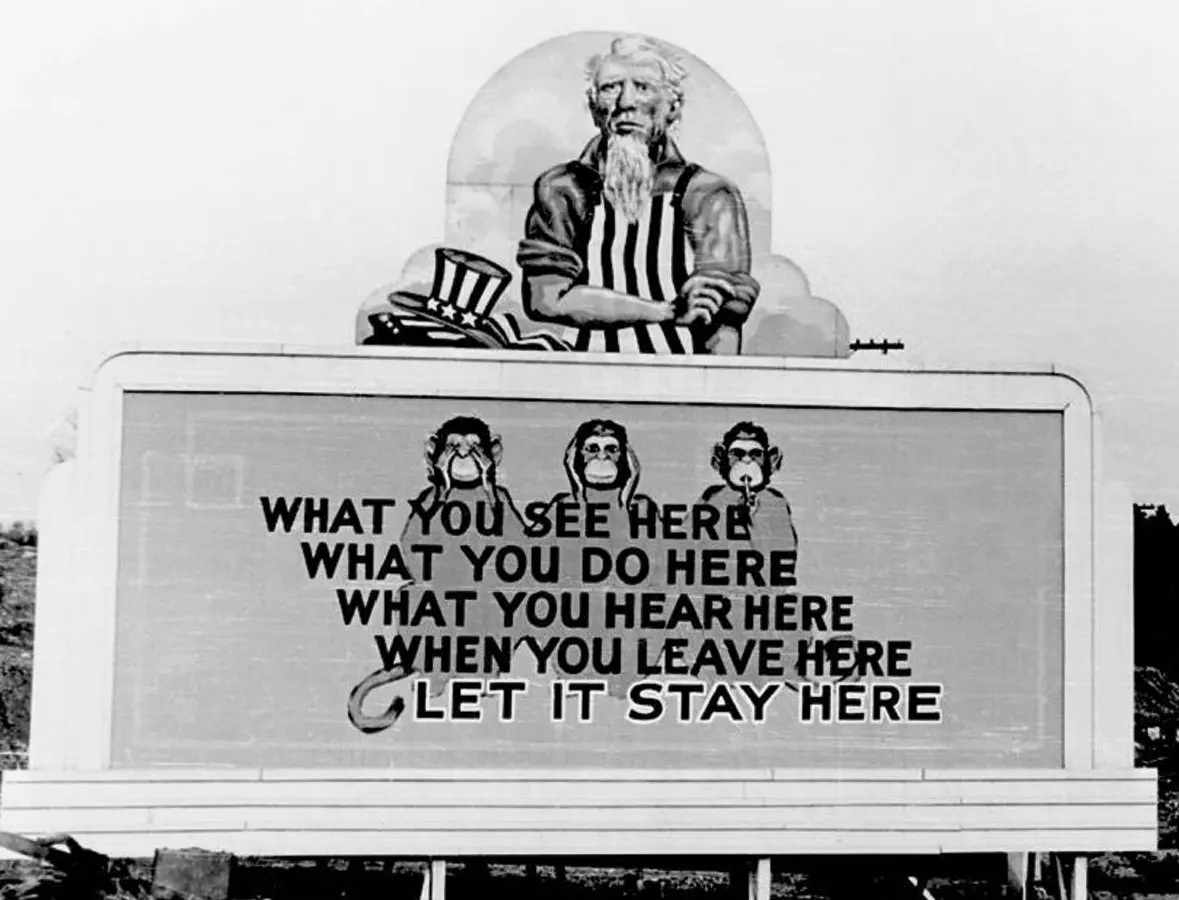
A billboard for Manhattan Project workers at Oak Ridge, 1940s. Photo: Ed Westcott, U.S. government (public domain, via Wikimedia Commons).
And it worked, at least for that one job. In a production race, the women at Oak Ridge reportedly outproduced the trained physicists from Berkeley. Kenneth Nichols, one of the Army officers running the project, put it this way: “the girls won because they were trained like soldiers.” They didn’t need to know why. They needed to follow the instructions.
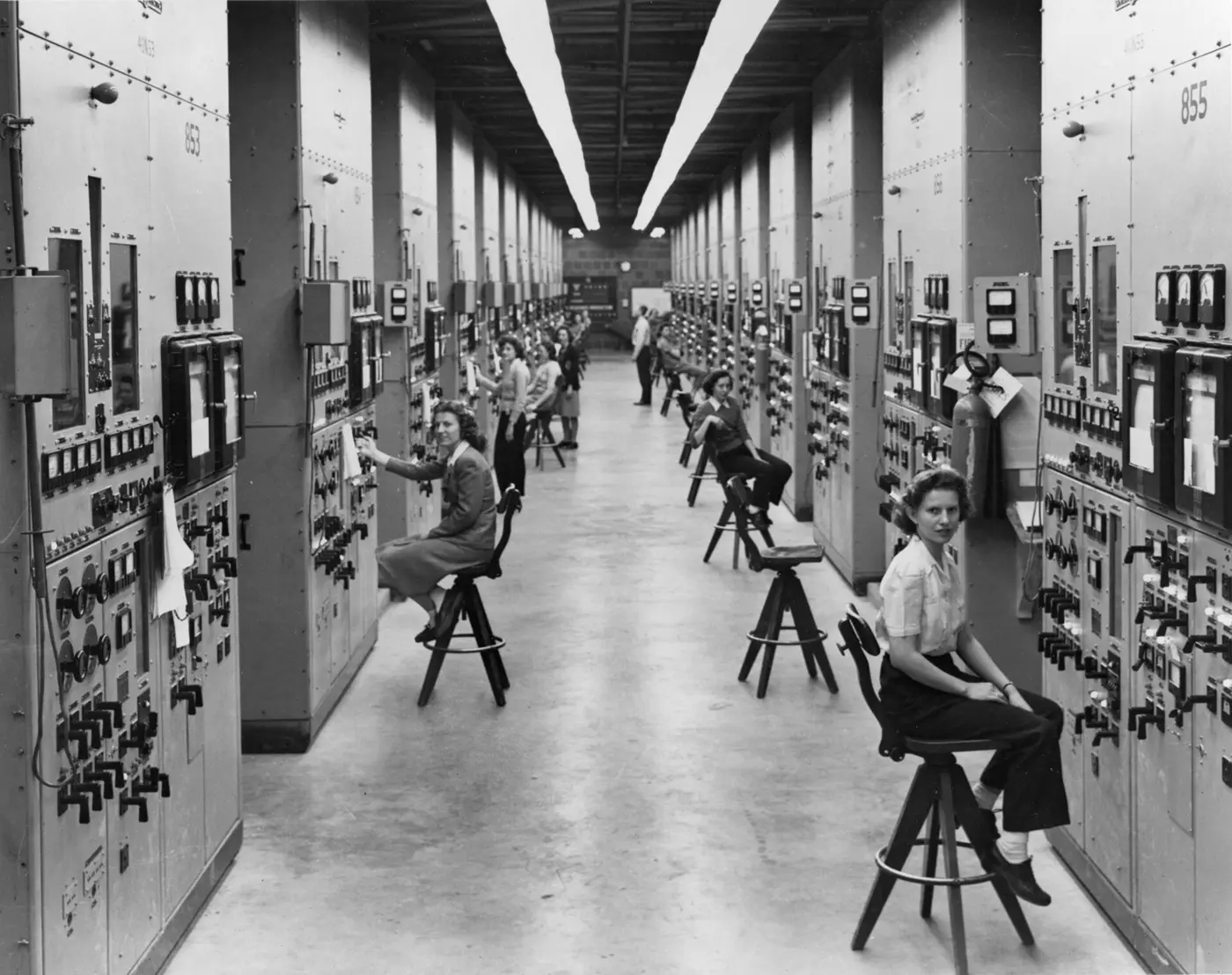
Calutron operators at the Y-12 plant, Oak Ridge, 1944. Photo: Ed Westcott, U.S. Department of Energy (public domain, via Wikimedia Commons).
So secrets can work. The question is what happens when the work needs people to think, not just follow the steps.
What happened when Feynman told them
Richard Feynman worked on the same project, at Los Alamos. He told two stories about it years later, in a talk called “Los Alamos from Below.”
The first is about speed. Feynman ran a group of young Army recruits who did calculations on punch-card machines. Nobody had told them what the calculations were for. Feynman got permission to explain the project, and everything changed. They started inventing better methods and working nights without being asked. In his words: “although it took them nine months to do three problems before, we did nine problems in three months, which is nearly ten times as fast.”
That’s one man remembering his own team 30 years later, so treat the exact numbers with care. But his conclusion is the whole point of this post: “all that had to be done was to tell them what it was, that’s all.”
The second is about safety. Feynman was sent to Oak Ridge to make sure the plant stored uranium safely. The Army told him to give the staff the rules but not the reasons. Feynman pushed back: “In my opinion it is impossible for them to obey a bunch of rules unless they understand how it works.” Once he explained, the plant’s own people started working out their own safety calculations. He wrote that “the plant would have blown up if nobody had paid attention to this problem.”
Secrets have a price tag
The U.S. government is the one organization that actually adds up what its secrets cost. Every year, its Information Security Oversight Office asks agencies what they spend on classification: clearances, guards, locked systems, training, and the managers who oversee all of it. Look at how the number grew:
By 2017, with the intelligence agencies counted in, the total was $18.39 billion a year, plus $1.49 billion spent by private companies working with the government. The office that publishes those numbers didn’t spin them. It called the cost “prohibitive,” and wrote that “too much classification impedes the proper sharing of information necessary to respond to security threats.”
That’s the government saying its own secrecy gets in the way of its own work.
Your team doesn’t have a budget line for this. But it pays the same kinds of costs: the separate version of the email for each group, the second review before anything goes out, the meeting about who should be in the meeting, and the person who can’t do their job well because nobody told them what it was for.
Secrets also cost trust
There’s a quieter cost too. The people who hold the secrets usually think things are more open than they are.
In a 2025 SurveyMonkey study of 3,573 US workers, 56% of senior leaders said they’d expect leadership to be fully supportive and transparent if asked about strategy and finances. Only 32% of individual contributors said the same. Same companies, very different picture.
I wrote about where that leads in The Kickoff Cliff. In a 2023 meta-analysis of 131 studies, hiding knowledge at work went hand in hand with distrust and with lower psychological safety (the sense that it’s safe to speak up). That’s a correlation, not proof that one causes the other. But anyone who’s worked in a need-to-know culture knows how it feels.
Even Apple ran into this. Its secrecy was widely reported to be hurting its ability to hire AI researchers, who want to publish their work. “Most people I know don’t even interview at Apple,” one University of Toronto researcher told The Register in 2017. In December 2016, Apple said its AI researchers would be allowed to publish, and in 2017 it started a public machine learning journal. The most secretive company in tech opened up exactly where secrecy was costing it talent.
Where I draw the line
I’m not saying everything should be public. Some secrets are the right call:
- Other people’s private information. Health records, pay, personnel issues. That isn’t secrecy. That’s respect, and often the law.
- Room to try things. Harvard’s Ethan Bernstein found that when a factory put curtains around four of its production lines so workers weren’t watched all the time, output on those lines rose by as much as 10–15%. A little privacy let people try better ways of working.
- Launch timing. Apple’s surprise announcements are a real business choice.
What these have in common is that they’re specific. One record, one draft, one launch date. The trouble starts when need-to-know turns into the default for everything, and every email, every update and every decision has to be checked before anyone can see it.
So here’s what I’d suggest:
- Keep the data secret, not the work. Lock down the record that’s truly sensitive. Let people see the project, the plan and the decisions.
- Make open the default and private a decision. If something is restricted, someone should be able to say why in one sentence.
- Tell people what the work is for. It’s the cheapest speed-up in this whole post. Feynman got his with one lecture.
- Count the checking. Next time a rule about who-sees-what adds a step, write down how long it takes. Seeing the number changes the conversation.
- Ask before you assume. The person who wants something kept need-to-know may have a good reason, or may not know what the rule is costing. Either way, a short conversation beats weeks of workarounds.
Most of the time, nobody is the villain here. People keep secrets to protect something they care about. I just think we should know the price before we pay it.
How much of your week goes to keeping things need-to-know? Tell me in the comments.
Sources
- Feynman, R. (1975). Los Alamos from Below. Engineering and Science, Caltech.
- Wikipedia. Calutron Girls (workforce size, production race, Nichols quote).
- Information Security Oversight Office. 2011 Cost Report and 2017 Report to the President. National Archives.
- SurveyMonkey workplace research (2025), 3,573 full-time US workers, non-probability online panel.
- Škerlavaj, Černe & Batistič (2023). Knowledge hiding meta-analysis. Economic and Business Review, 25(2).
- The Register (2017). Apple begins AI blog to beguile boffins.
- Bernstein, E. (2012). The transparency paradox. Administrative Science Quarterly, 57(2).
- Photos: Ed Westcott, U.S. government, public domain, via Wikimedia Commons (billboard, Calutron operators).
 JobKick support


Comments
Loading comments…