Helping Someone Is Really Helping Yourself

Alfonso was my contractor on a building rehab I had going in Hoboken. He’s an amazing guy. And like everybody else right now, he’s been feeling the economy.
When people do work for me, I generally tip in cash. This was different. It was a long-term project, and I wanted to do something a little better for him. I realized he didn’t have a website, and he told me he doesn’t know how to use a computer that well.
So I gave him a different kind of tip: a website.
The first version of his site is live now at allgeneralcontractors.com. I thought I was doing something nice for him. It turned out I was doing something for me, too. This post is about that.
How Helpful Soul started
It started with a burrito place.
I needed a website and a bulletin board system for El Barrio Burritos. I wanted to build one, and I knew I could. But I thought to myself: wouldn’t it be cool if I built something that could build systems for other businesses?
That’s how Helpful Soul was born. It’s a community board where people ask for help and offer it, and part of what it does is build websites for local businesses. It’s my own project, separate from JobKick.
The first site it built was El Barrio Burritos, at elbarriobk.com. Menu, online ordering, a photo board where customers post their pictures, and the whole thing in 20 languages.
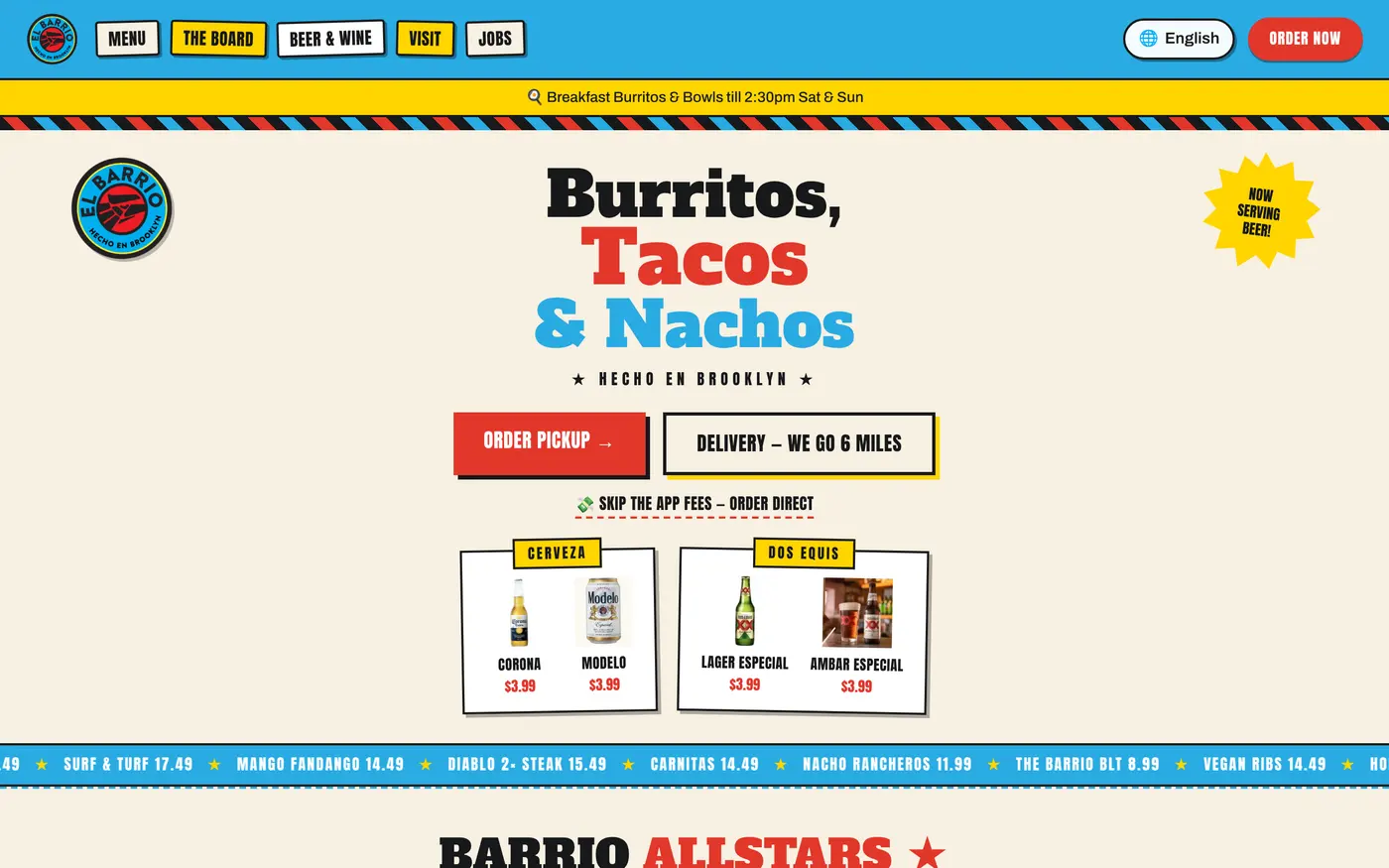
elbarriobk.com, the first site Helpful Soul built. (Screenshot, October 2026.)
Then came Alfonso
A restaurant site taught the builder how restaurants work. A contractor is a different business.
People don’t order a kitchen renovation online. They want to know what you do, where you work, how you work, and whether they can trust you in their house. So Alfonso’s site is built around that. It lists his services (kitchens, baths, floors, additions, whole-home work), the towns he works in, from Hoboken and Jersey City to Montclair and Maplewood, and the steps from first walk-through to final punch list. There’s a free-estimate form at the bottom.

allgeneralcontractors.com, version one. (Screenshot, October 2026.)
It’s honest about where it is, too. The “Our work” section says project photos are coming soon. Version one, like I said.
What I didn’t know yet
Something I really learned while building Alfonso’s site: I don’t know enough about how his business works yet.
His site lays out how a job goes, in five steps, from the first walk-through to the final one. Writing those steps down was the easy part.
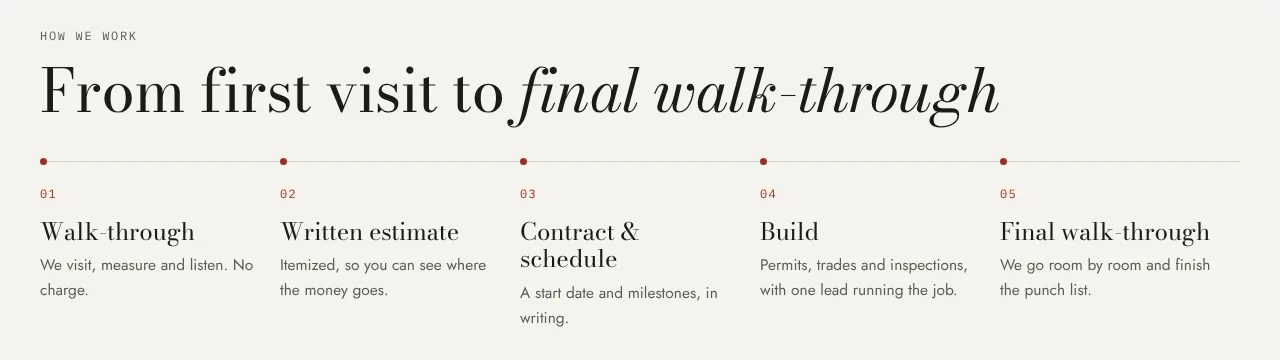
The “How we work” timeline on allgeneralcontractors.com. (Screenshot, October 2026.)
So I made a high-level plan to learn more about his business and work on it with him, using SyncUp, the project management app we built at JobKick. And I get a chance to teach Alfonso how to use project management software at the same time. One more thing to give.
What it gave back
Here’s how I’d put it.
I was able to give him something very valuable. That’s going to help his business for years to come. And I also learned how to make my website-building application better by using him as a test case. Helping give him the best site he needs allows me to have a better product.
Today the builder’s first question is “What kind of business?”, and there are two answers: “Restaurant or café” and “Contractor or trades.” A burrito place and a contractor.
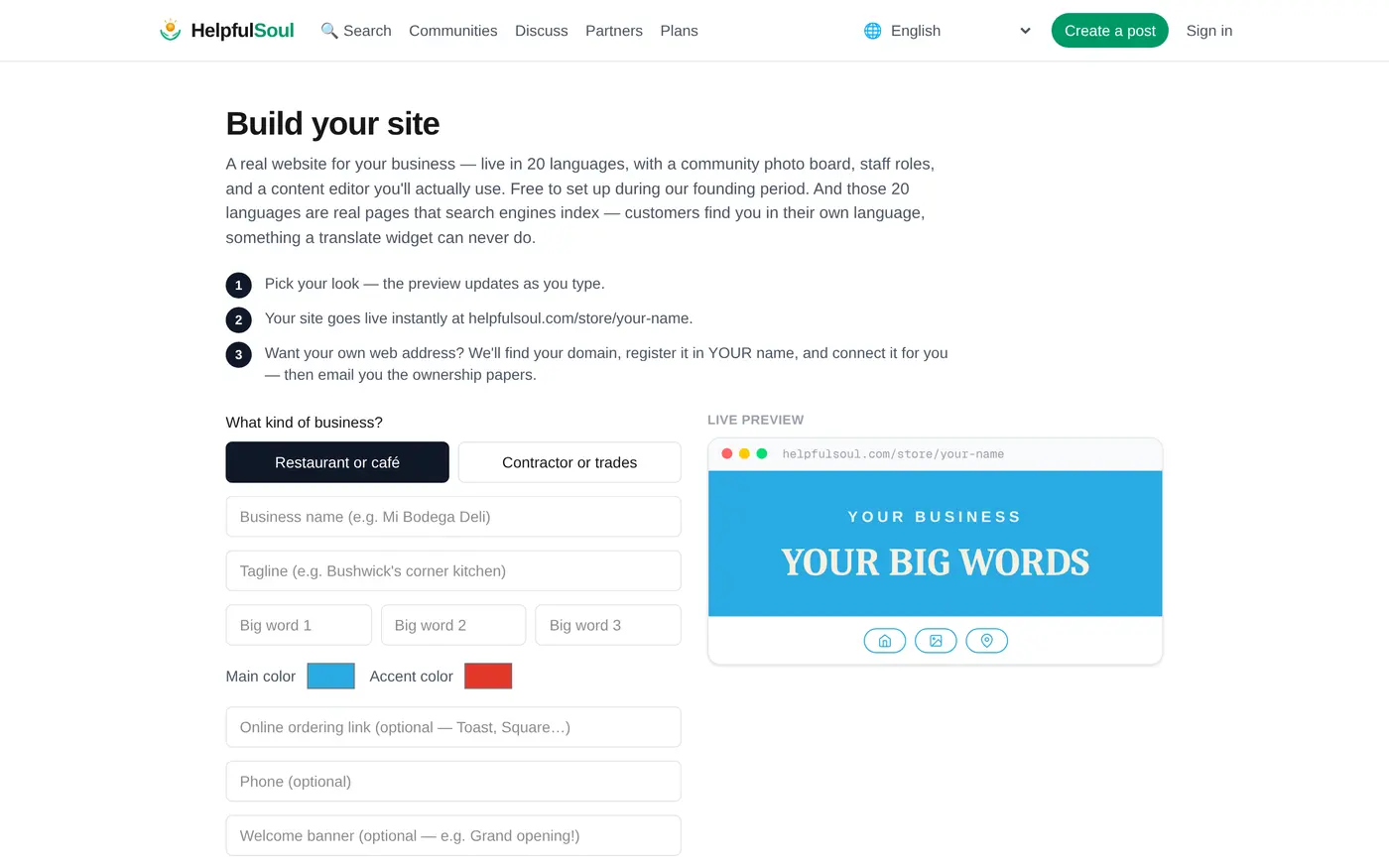
Helpful Soul’s site builder. (Screenshot, October 2026.)
This isn’t just a nice feeling
Two different bodies of research point the same way.
Helping feels good, and not just in one culture. In 2008, Elizabeth Dunn, Lara Aknin and Michael Norton handed 46 people an envelope with $5 or $20 in the morning and told them to spend it by 5:00 p.m. Some had to spend it on themselves, some on a gift for someone else or a donation. The ones who spent it on others were happier by the evening. How much they got didn’t matter; who they spent it on did. In a second study in the same paper, 16 employees who got a profit-sharing bonus were happier later if they had spent more of it on others, and how they spent it mattered more than how big it was.
A 2013 follow-up looked at Gallup World Poll data from 136 countries (234,917 people, 2006 to 2008). Giving to charity went with higher happiness in 120 of those 136 countries, rich and poor alike. In the authors’ model, donating had about the same link to well-being as doubling your household income. That part is a correlation, not proof, so the team also ran experiments in Canada, Uganda and India, where people asked to remember a time they spent money on someone else came out happier.
Building for a real person makes better things. MIT’s Eric von Hippel has spent decades studying where new products actually come from. In his book Democratizing Innovation (2005), he reports that across the fields studied, 10% to nearly 40% of users develop or modify products for their own use, and that users developed about 80% of the most important scientific instrument innovations in his 1988 study. The people with the real problem often see the fix first.
Paul Graham gives startup founders similar advice in his 2013 essay “Do Things That Don’t Scale”: pick a single user and build “something just for that one user.” His line: “The initial user serves as the form for your mold; keep tweaking till you fit their needs perfectly, and you’ll usually find you’ve made something other users want too.”
That’s Alfonso. He was the mold.
The fair pushback
Two honest caveats.
First, the happiness research is smaller and messier than the headlines suggest. Most of the early studies used small groups. In 2020, Aknin, Dunn and colleagues ran large, preregistered replications (they published their plan before collecting data). The first one, with 712 students, worked. The second, with 1,950 adults recalling past spending, found no difference. A third, with 5,199 people, found an effect, but a small one. Their own conclusion: spending on others does promote happiness, but how much depends on how you measure it.
Source: Dunn, Aknin & Norton, Science (2008); Aknin et al., Journal of Personality and Social Psychology (2020)
Second, “helping you helps me” can sound a little transactional. If I’d built Alfonso a site only to test my software, that’s not a gift, it’s unpaid testing with a bow on it. Graham makes a related point: being extra attentive to someone works fine as long as you’re not being paid for it, because the minute it’s billed by the hour, the deal changes.
Where I land: the help has to come first, and it has to be real. Alfonso needed a website whether or not my builder learned anything. The fact that I got something back doesn’t make the gift smaller. It’s just why this kind of help keeps happening.
The pattern
None of this needs a website builder. It works with almost any skill.
- Pick one real person with a problem you know how to solve. A friend’s shop, a neighbor’s group, the contractor who just fixed your floor.
- Build it for them, not for “users.” Their business, their customers, their words. Specific beats general.
- Give it fully. No catch, no upsell. It should help them even if you never touch it again.
- Write down what surprised you. Where they got stuck, what they asked for that you never thought of. That list is the part that helps you.
- Do it again with someone different. A burrito place and a contractor taught my builder very different things.
Your turn
Have you ever helped someone and gotten more back than you expected? Or helped someone and gotten nothing back, and still been glad you did? Tell me in the comments.
Sources
- Dunn, E. W., Aknin, L. B., & Norton, M. I. (2008). Spending Money on Others Promotes Happiness. Science 319, 1687–1688. (Windfall experiment, N = 46; bonus study, N = 16.)
- Aknin, L. B., Barrington-Leigh, C. P., Dunn, E. W., Helliwell, J. F., et al. (2013). Prosocial Spending and Well-Being: Cross-Cultural Evidence for a Psychological Universal. Journal of Personality and Social Psychology 104(4). (Gallup World Poll, 136 countries, N = 234,917.)
- Aknin, L. B., Dunn, E. W., Proulx, J., Lok, I., & Norton, M. I. (2020). Does Spending Money on Others Promote Happiness? A Registered Replication Report. Journal of Personality and Social Psychology 119. (Free preprint.)
- von Hippel, E. (2005). Democratizing Innovation. MIT Press, chapter 2 (free PDF).
- Graham, P. (2013). Do Things That Don’t Scale.
- All General Contractors, El Barrio Burritos and Helpful Soul’s “Build your site” page, accessed October 18, 2026.
- Mentioned: Helpful Soul (my side project) and SyncUp (JobKick’s project management app).
 JobKick support
Comments
Loading comments…